
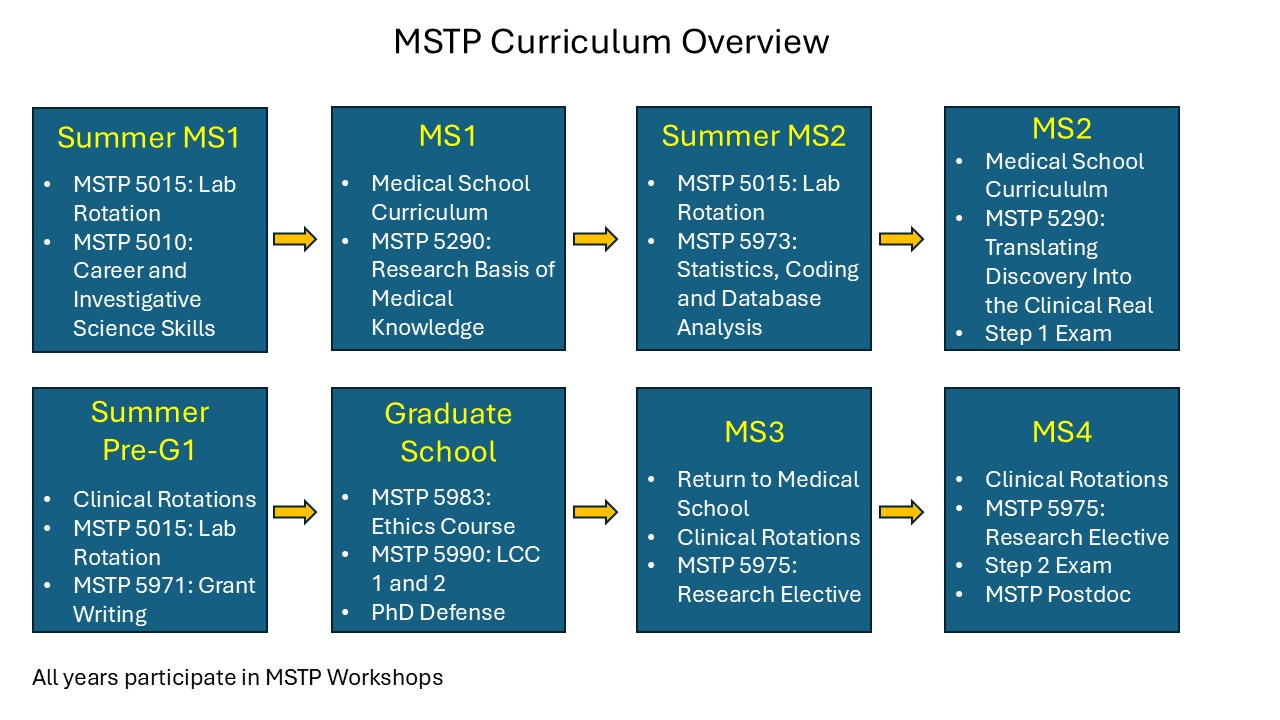
Given the breadth of research and clinical programs available in the MSTP, it is impossible to define a single path through the combined degree. Although rare students have completed training in six years, the following diagram illustrates a typical path through the MSTP, highlighting the MSTP-specific courses that are taken each year.
Professional Development I: Career and Investigative Science Skills (CISS)
This course is designed for entering MSTP students. The purpose of this course is to highlight contemporary questions in biomedicine and how different scientific fields approach these questions. Students are exposed to physician-scientist role models who share information about their career paths, the compelling questions in their field, and how they design experiments to address gaps in knowledge and build a coherent research path within their field. The course also builds student skills in planning and presenting their work.
Research Basis of Medical Knowledge (RBMK)
This small group session is restricted to MSTP students during their first year of medical school. The class meets to review primary literature linked to the current curricula. Students learn about the research basis of medical knowledge, and how to present and critically review primary literature. In the second semester of the course, each session critically discusses a basic science paper coupled to a relevant clinical paper to reinforce the ultimate impact of the implementation of basic science.
Professional Development II: Statistics, Coding, and Database Analysis (SCDA)
This course is designed for MSTP students during the summer between the first and second year of medical school. The learning objectives of the course is to learn fundamental research skills using the NIH AllofUs database including use of its genomic, demographic and medical record data. Attention is focused on relevant statistics and R-coding, reproducibility and rigor in the conduct and analysis of experiments, appropriate data and handling and use of biostatistics, and guidelines for reporting methods and results.
Translating Discovery into the Clinical Realm (Discov2Clinic)
The Translating Discovery into the Clinical Realm course provides a broad overview of how scientific discoveries are put into clinical practice. The primary objective of this course is to educate future physician-scientists about the scope and complexities of the translational science pipeline early in their careers so they can consider how factors downstream of an initial scientific discovery affect its societal impact.
Professional Development III: Grant Writing (Grants)
This course is required of MSTP students after their second year of medical school. The course focuses on grant writing and the review process with emphasis on the NIH F30 grant mechanism. A small amount of lecture material is linked to a series of workshops where each student composes a bio sketch, specific aims, experimental plan, and training plan related to their PhD thesis. Constructive peer critiquing of grant material provides a perspective on which to build grant-writing skills.
Ethics for Medical Scientists (Ethics)
This course is offered to MSTP students during the first spring in graduate school. It consists of 4-5 two-hour-long sessions. The introductory workshop is designed to teach participants how to apply analytical methods systematically to the evaluation of ethical dilemmas. The objective of the later workshop sessions is to build upon these principles within the context of specific biomedical ethics cases. The course provides a framework based to translate conceptual methodologies into practical skills for evaluating ethical dilemmas.
Longitudinal Clinical Clerkships 1 and 2 (LCC1 and LCC2)
Taken during graduate school training, each of these two 20 half-day-per-week electives allows the students to explore their clinical interests. Students work one-on-one with an attending academic physician who oversees their learning of advanced clinical skills in interviewing and physical diagnosis. Students evaluate patients in specialty outpatient clinics and plan and present appropriate evaluations and therapeutic plan both for new symptoms and for health maintenance. Emphasis is placed on the role of the clinical investigator overseeing the care of patients.
Longitudinal Clinical Clerkship 3 (LCC3)
This clerkship is a two week transitional inpatient junior hospitalist rotation taken prior to completing graduate school and transitioning back to medical school. During this course students join a general medicine service team with three residents and an attending. Each student follows one to two patients conducting exams, writing notes, presenting their findings to the residents and attendings during rounds, and receiving structured feedback.
Workshops
This discussion-based course, guided by faculty preceptors, meets 8 times per year over dinner and is attended by MSTP students from all years in the program. Each class begins with a description of a topic related to training as a physician-scientist. The topic for discussion is developed by students from different years in order to assure a good representation of various stages of training. Discussion of ethically challenging situations underscores the understanding that responsible conduct of research and medicine as a critical aspect of research training and that it remains an important concern at all levels of a research career.. The workshops also provide a venue in which junior students can learn from senior students.